Flag the two places where a range that moved between the two genomes is seen in the order of the target genome: the payload region, where the moved range is found on the target genome, and the site, where it is found on the query genome.
Arguments
- gb
A
GBreaks()object.- tol
Ranges separated by more than
tolunaligned bases are not considered adjacent:U,AandVon the target genome andUandVon the query genome for payload regions;XandYon the target genome andX,AandYon the query genome for sites.
Value
Returns the GBreaks object with two extra metadata columns, tra
and trs, flagging the payload regions and the sites.
Details
A range A moved between the two genomes when, for instance:
The payload region is a triplet of consecutive ranges
U A Von one target sequence, such thatUandVare on the same strand and would be colinear ifAwere removed. Thetraflag is set onU.The site is a pair of consecutive ranges
X Yon one target sequence, on the same strand, such thatAis found between them on the query genome, and thatX A Ywould be colinear ifAwere on the same strand asXandY. Thetrsflag is set onX.
A can be on either strand, and on any target sequence. When one of the
two genomes has no context for A, for instance when it is alone on its
sequence, only one of the two flags is set. When both are set, they
designate the same range A. The function therefore detects transpositions
of single ranges, whether or not they change sequence.
Here is a trivial example of a translocation, where the query genome has no context for the moved range, so that only the payload region is flagged:
┌──────────────┬──────────────┬──────────────┐
│ chrA:101-200 │ chrA:201-300 │ chrA:301-400 │ (Target genome)
└──────────────┴──────────────┴──────────────┘
       +               +             +         (Alignment direction)
┌──────────────┬──────────────┬──────────────┐
│ chrB:101-200 │ chrC:201-300 │ chrB:301-400 │ (Query genome)
└──────────────┴──────────────┴──────────────┘
Note
Before version 0.25.0, the site was flagged only with the both
option, by a tra flag on the query ranges, set on the first range of the
site in query order.
Unstranded ranges (experimental)
Ranges on the * strand are considered adjacent in either direction. When
orientation is unknown, moving one range over a segment can not be told
apart from moving the segment over the range, so that more ranges are
flagged as moved: for instance, with the target genome X Y U A V and the
query genome X A Y U V, Y and U are flagged in addition to A.
This behaviour may change in future versions.
See also
Other Flagging functions:
flagAll(),
flagColinearAlignments(),
flagDoubleInversions(),
flagInversions(),
flagLongShort(),
flagPairs(),
flagTwinInversions()
Other Translocation functions:
filterTranslocations(),
removeTranslocations(),
showTranslocations()
Other Structural variants:
StructuralVariants,
flagDoubleInversions(),
flagInversions(),
flagPairs(),
flagTwinInversions(),
plotApairOfChrs()
Examples
flagTranslocations(exampleTranslocation)
#> GBreaks object with 3 ranges and 3 metadata columns:
#> seqnames ranges strand | query tra trs
#> <Rle> <IRanges> <Rle> | <GRanges> <Rle> <Rle>
#> [1] chrA 100-200 + | chrB:100-200 TRUE FALSE
#> [2] chrA 201-300 + | chrC:201-300 FALSE FALSE
#> [3] chrA 301-400 + | chrB:301-400 FALSE FALSE
#> -------
#> seqinfo: 1 sequence from an unspecified genome
# The ranges U and V are separated by 100 bases on the query genome.
flagTranslocations(exampleTranslocation, tol = 100)
#> GBreaks object with 3 ranges and 3 metadata columns:
#> seqnames ranges strand | query tra trs
#> <Rle> <IRanges> <Rle> | <GRanges> <Rle> <Rle>
#> [1] chrA 100-200 + | chrB:100-200 TRUE FALSE
#> [2] chrA 201-300 + | chrC:201-300 FALSE FALSE
#> [3] chrA 301-400 + | chrB:301-400 FALSE FALSE
#> -------
#> seqinfo: 1 sequence from an unspecified genome
flagTranslocations(exampleTranslocation, tol = 99)
#> GBreaks object with 3 ranges and 3 metadata columns:
#> seqnames ranges strand | query tra trs
#> <Rle> <IRanges> <Rle> | <GRanges> <Rle> <Rle>
#> [1] chrA 100-200 + | chrB:100-200 FALSE FALSE
#> [2] chrA 201-300 + | chrC:201-300 FALSE FALSE
#> [3] chrA 301-400 + | chrB:301-400 FALSE FALSE
#> -------
#> seqinfo: 1 sequence from an unspecified genome
flagTranslocations(exampleTranslocation2)
#> GBreaks object with 3 ranges and 3 metadata columns:
#> seqnames ranges strand | query tra trs
#> <Rle> <IRanges> <Rle> | <GRanges> <Rle> <Rle>
#> [1] chrA 100-200 + | chrB:100-200 TRUE FALSE
#> [2] chrA 201-300 - | chrC:201-300 FALSE FALSE
#> [3] chrA 301-400 + | chrB:301-400 FALSE FALSE
#> -------
#> seqinfo: 1 sequence from an unspecified genome
plotApairOfChrs(exampleTranslocation)
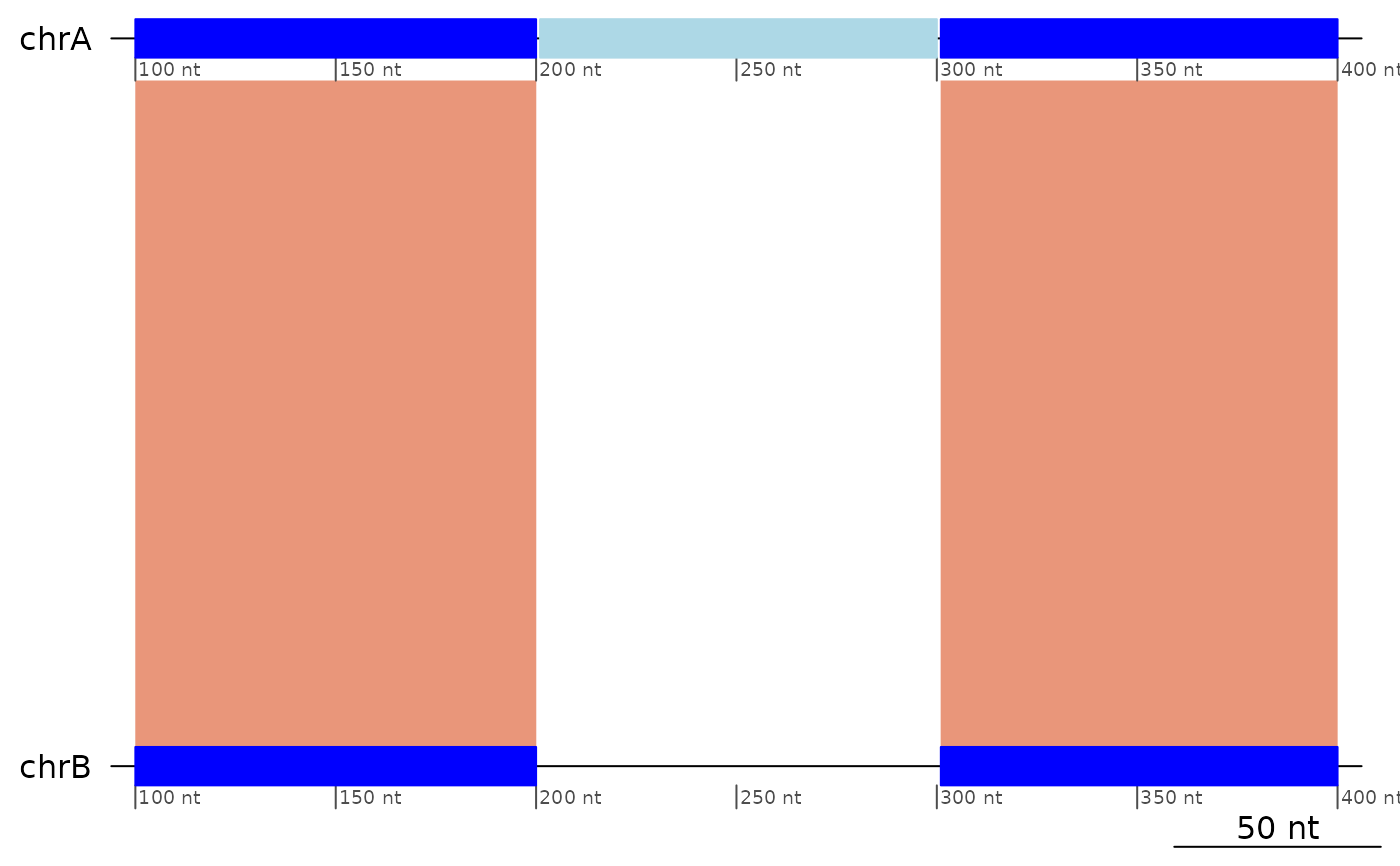 # When the genomes are swapped, the moved range has no context on the
# target genome, and only the site is flagged.
flagTranslocations(swap(exampleTranslocation, sort = TRUE))
#> GBreaks object with 3 ranges and 3 metadata columns:
#> seqnames ranges strand | query tra trs
#> <Rle> <IRanges> <Rle> | <GRanges> <Rle> <Rle>
#> [1] chrB 100-200 + | chrA:100-200 FALSE TRUE
#> [2] chrB 301-400 + | chrA:301-400 FALSE FALSE
#> [3] chrC 201-300 + | chrA:201-300 FALSE FALSE
#> -------
#> seqinfo: 2 sequences from an unspecified genome
# A move along one sequence is seen at both places.
gb <- permutationVectorToGBreaks(c(1, 3, 4, 2, 5))
flagTranslocations(gb)
#> GBreaks object with 5 ranges and 3 metadata columns:
#> seqnames ranges strand | query tra trs
#> <Rle> <IRanges> <Rle> | <GRanges> <Rle> <Rle>
#> [1] chrT1 100-189 + | chrQ1:100-189 FALSE TRUE
#> [2] chrT1 200-289 + | chrQ1:300-389 FALSE FALSE
#> [3] chrT1 300-389 + | chrQ1:400-489 TRUE FALSE
#> [4] chrT1 400-489 + | chrQ1:200-289 FALSE FALSE
#> [5] chrT1 500-589 + | chrQ1:500-589 FALSE FALSE
#> -------
#> seqinfo: 1 sequence from an unspecified genome
flagTranslocations(exampleDeletion)
#> GBreaks object with 3 ranges and 3 metadata columns:
#> seqnames ranges strand | query tra trs
#> <Rle> <IRanges> <Rle> | <GRanges> <Rle> <Rle>
#> [1] chrA 100-200 + | chrB:100-200 TRUE FALSE
#> [2] chrA 201-300 + | chrC:401-500 FALSE FALSE
#> [3] chrA 301-400 + | chrB:201-300 FALSE FALSE
#> -------
#> seqinfo: 1 sequence from an unspecified genome
flagTranslocations(exampleInsertion)
#> GBreaks object with 3 ranges and 3 metadata columns:
#> seqnames ranges strand | query tra trs
#> <Rle> <IRanges> <Rle> | <GRanges> <Rle> <Rle>
#> [1] chrA 100-200 + | chrB:100-200 FALSE TRUE
#> [2] chrA 201-300 + | chrB:301-400 FALSE FALSE
#> [3] chrC 401-500 + | chrB:201-300 FALSE FALSE
#> -------
#> seqinfo: 2 sequences from an unspecified genome
flagTranslocations(exampleInsertion |> swap(sort = TRUE))
#> GBreaks object with 3 ranges and 3 metadata columns:
#> seqnames ranges strand | query tra trs
#> <Rle> <IRanges> <Rle> | <GRanges> <Rle> <Rle>
#> [1] chrB 100-200 + | chrA:100-200 TRUE FALSE
#> [2] chrB 201-300 + | chrC:401-500 FALSE FALSE
#> [3] chrB 301-400 + | chrA:201-300 FALSE FALSE
#> -------
#> seqinfo: 1 sequence from an unspecified genome
flagTranslocations(sort(reverse(exampleDeletion), ignore.strand = TRUE))
#> GBreaks object with 3 ranges and 3 metadata columns:
#> seqnames ranges strand | query tra trs
#> <Rle> <IRanges> <Rle> | <GRanges> <Rle> <Rle>
#> [1] chrA 201-300 - | chrB:201-300 TRUE FALSE
#> [2] chrA 301-400 - | chrC:401-500 FALSE FALSE
#> [3] chrA 401-501 - | chrB:100-200 FALSE FALSE
#> -------
#> seqinfo: 1 sequence from an unspecified genome
flagTranslocations(exampleInversion)
#> GBreaks object with 3 ranges and 3 metadata columns:
#> seqnames ranges strand | query tra trs
#> <Rle> <IRanges> <Rle> | <GRanges> <Rle> <Rle>
#> [1] chrA 100-190 + | chrB:100-190 FALSE FALSE
#> [2] chrA 210-291 - | chrB:210-291 FALSE FALSE
#> [3] chrA 301-400 + | chrB:301-400 FALSE FALSE
#> -------
#> seqinfo: 1 sequence from an unspecified genome
flagTranslocations(exampleColinear3)
#> GBreaks object with 3 ranges and 3 metadata columns:
#> seqnames ranges strand | query tra trs
#> <Rle> <IRanges> <Rle> | <GRanges> <Rle> <Rle>
#> [1] chrA 100-200 + | chrB:100-200 FALSE FALSE
#> [2] chrA 201-300 + | chrB:201-300 FALSE FALSE
#> [3] chrA 301-400 + | chrB:301-400 FALSE FALSE
#> -------
#> seqinfo: 1 sequence from an unspecified genome